
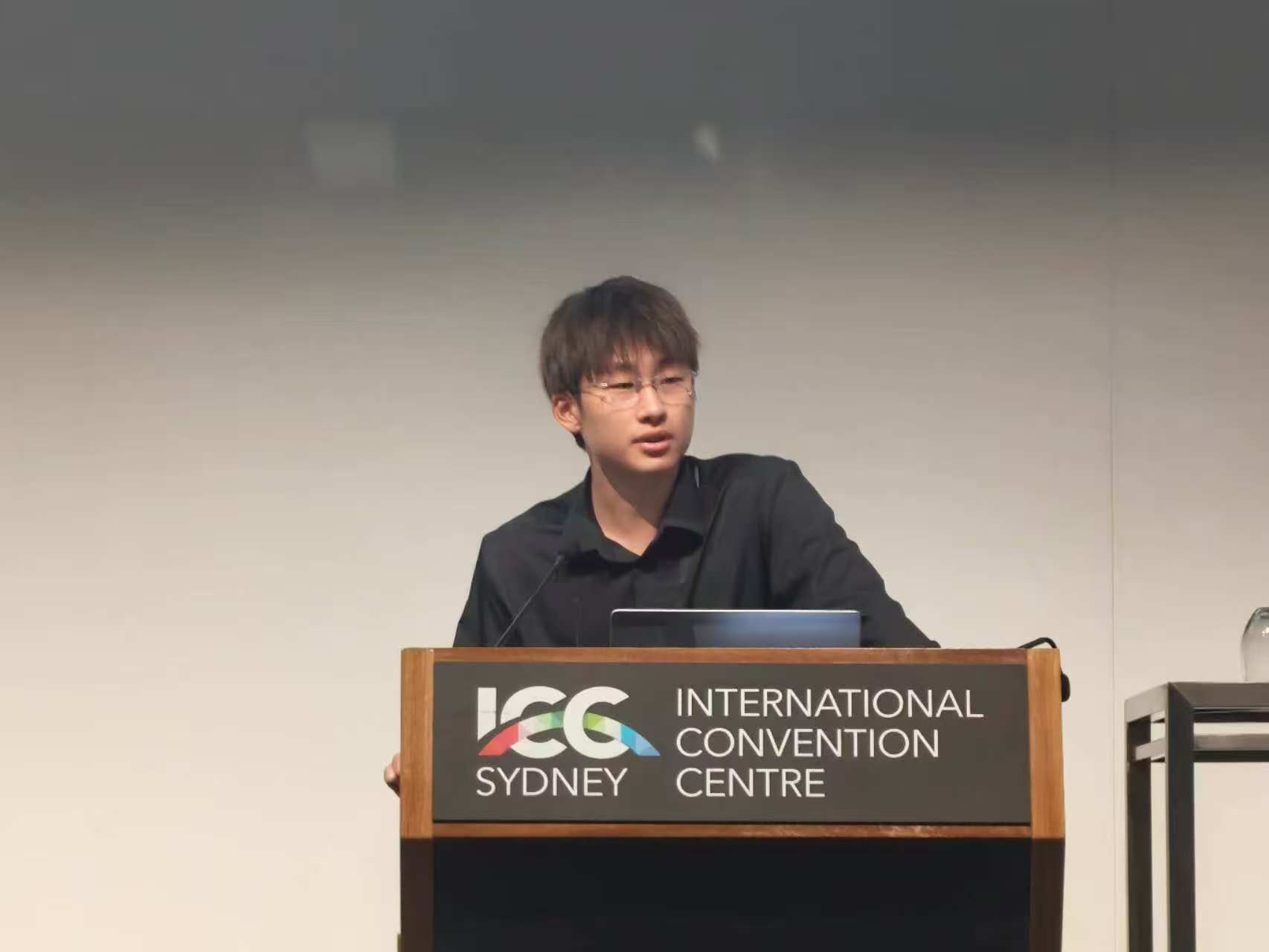

 PhD student @ HKBU
I am Wenjun Yu (俞文军), a second-year Ph.D. student in Computer Science at Hong Kong Baptist University, supervised by Prof. Amelie Chi Zhou. Prior to that, I received my B.S. in Artificial Intelligence from Dalian University of Technology.
My research interests lie broadly in DLRM training/serving optimization, generative RecSys acceleration and GPU Virtualization techniques.
Outside of my academic work, I'm deeply curious about traditional Chinese metaphysics. I've explored systems such as Bazi, Ziwei Doushu, and Xiao Liu Ren, and enjoy studying how these classical frameworks interpret patterns, fate, and decision-making. Explore my life Bazi score K-line chart here.
Warning
Problem: The current name of your GitHub Pages repository ("Solution: Please consider renaming the repository to "
http://".
However, if the current repository name is intended, you can ignore this message by removing "{% include widgets/debug_repo_name.html %}" in index.html.
Action required
Problem: The current root path of this site is "baseurl ("_config.yml.
Solution: Please set the
baseurl in _config.yml to "🧑🎓Education
-
Hong Kong Baptist University

-
Dalian University of Technology


Honors & Awards
-
RPg Research Performance Award ($20,000 HKD)
Experience
-
Hong Kong Baptist University
-
VirtAi Tech

-
ZhuoShi Private Equity Fund

Selected Publications (view all )
When KV Meets Embeddings: Dynamic GPU Memory Allocation for Accelerating Generative Recommender Serving
Wenjun Yu, Amelie Chi Zhou, Shuguang Han — Alibaba (XianYu)
(SC 2026, CCF-A (19.2%)) International Conference for High Performance Computing, Networking, Storage, and Analysis
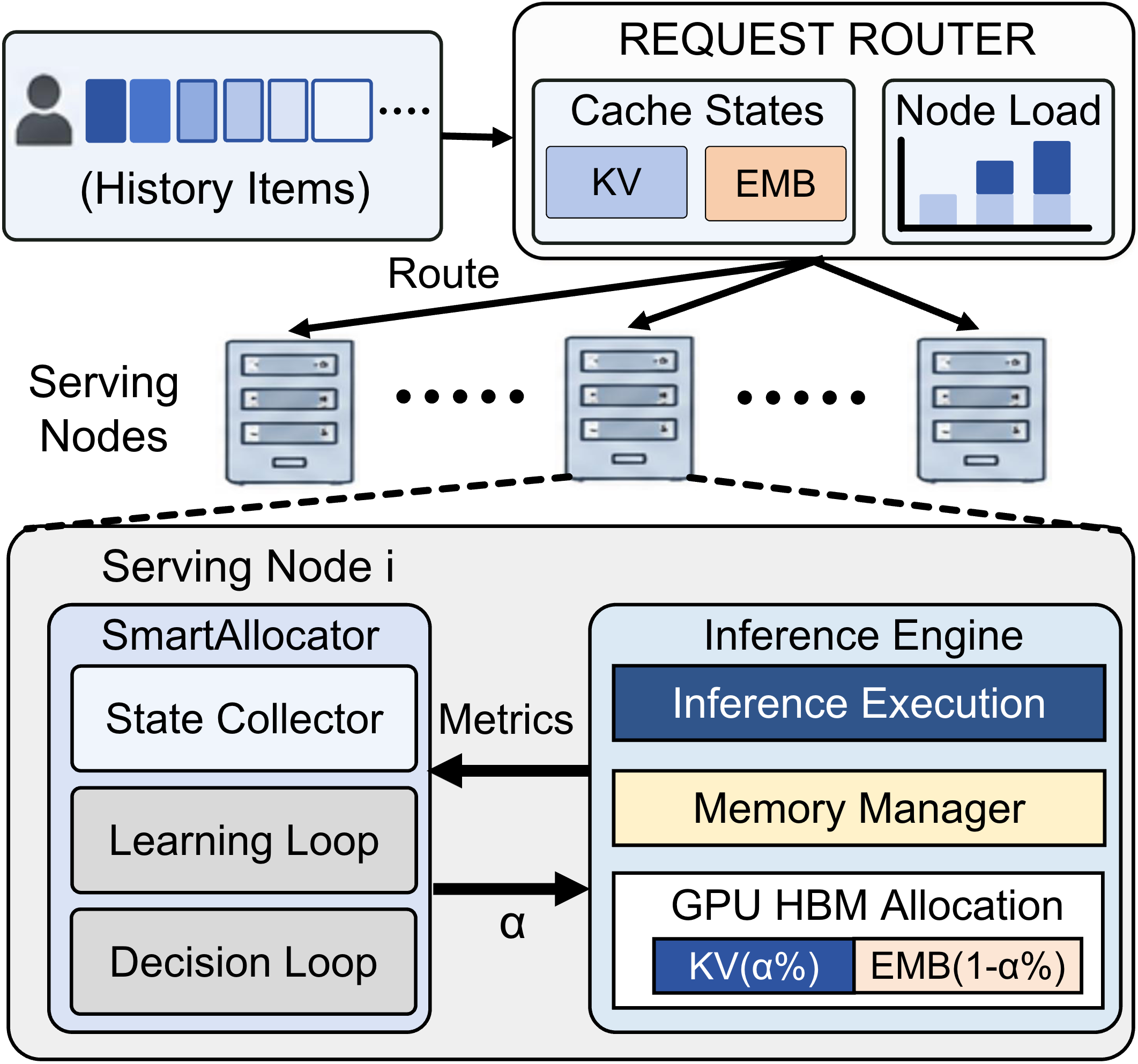
Generative Recommender inference faces a dual memory bottleneck absent in LLM serving: embedding hot caches and KV caches compete for the same limited GPU HBM, yet existing systems optimize them in isolation. We present RACER, which jointly reallocates HBM between the two caches at runtime and routes requests via a joint EMB–KV-aware scheduler, reducing P99 latency by 24–38% while maintaining ≥93.5% SLO satisfaction across production workload regimes.
When KV Meets Embeddings: Dynamic GPU Memory Allocation for Accelerating Generative Recommender Serving
Wenjun Yu, Amelie Chi Zhou, Shuguang Han — Alibaba (XianYu)
(SC 2026, CCF-A (19.2%)) International Conference for High Performance Computing, Networking, Storage, and Analysis
Generative Recommender inference faces a dual memory bottleneck absent in LLM serving: embedding hot caches and KV caches compete for the same limited GPU HBM, yet existing systems optimize them in isolation. We present RACER, which jointly reallocates HBM between the two caches at runtime and routes requests via a joint EMB–KV-aware scheduler, reducing P99 latency by 24–38% while maintaining ≥93.5% SLO satisfaction across production workload regimes.
Near-Zero-Overhead Freshness for Recommendation Systems via Inference-Side Model Updates
Wenjun Yu, Sitian Chen, Amelie Chi Zhou, Cheng Chen— ByteDance (Douyin)
(HPCA 2026, CCF-A (19.7%)) IEEE International Symposium on High-Performance Computer Architecture
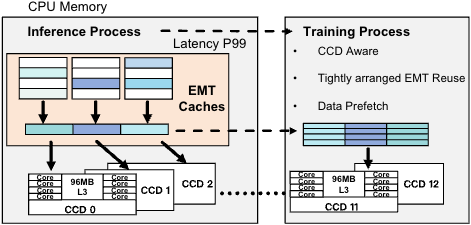
Updating online DLRMs is challenging due to their large model size. We address this by leveraging idle online CPU resources to perform continuous updates, thereby maintaining model freshness. Our approach employs dynamic rank adaptation and NUMA-aware resource scheduling to deliver these updates, significantly improving recommendation accuracy without impacting inference latency.
Near-Zero-Overhead Freshness for Recommendation Systems via Inference-Side Model Updates
Wenjun Yu, Sitian Chen, Amelie Chi Zhou, Cheng Chen— ByteDance (Douyin)
(HPCA 2026, CCF-A (19.7%)) IEEE International Symposium on High-Performance Computer Architecture
Updating online DLRMs is challenging due to their large model size. We address this by leveraging idle online CPU resources to perform continuous updates, thereby maintaining model freshness. Our approach employs dynamic rank adaptation and NUMA-aware resource scheduling to deliver these updates, significantly improving recommendation accuracy without impacting inference latency.